Immolated Memory
Lise Meitner made vital contributions to the discovery of nuclear fission. Her collaborator ensured she would never share the credit.

Day broke into a hazy mist in Berlin that July morning. The clouds that obscured the full moon overnight still hovered over the city. The air was cool, but not cold—unremarkable weather for an area known for its temperate climate, especially in the summers. Unremarkable too seemed the passenger boarding one of the city's many trains that day. Well into middle age, her dark brown hair parted away from her face, Lise Meitner hardly stood out from the average Berliner. She was dressed plainly and with few adornments. At one point during the trip, her traveling companion even advised her to remove her diamond ring to avoid attracting attention; she obliged. She had rarely, if ever, engaged in hurried acts of last-minute subterfuge. There was hardly any need: there were few enemies to be made in physics. Until now she had spent her life pursuing its seemingly endless puzzles. She pushed any thought that anyone might be pursuing her out of her mind.
Though Meitner never kept a record of her exact route, her train likely passed through the northern German countryside on its way to Groningen, a city on the eastern edge of the Netherlands. If she had looked, she would have seen an austere landscape. Millions of years before she boarded that train in her unassuming garb, the region experienced alternating glaciations that left behind scattered moraines: large boulders, smaller rocks, and scattered chips of glacial debris pushed against the hillsides. The forests—filled with towering oak and ashen birch after the last ice age—had been felled, replaced by fuchsia and lavender heather to support grazing herds of sheep. In some places the countryside was partly reforested with needle-tipped Scotch pine, which by summer would have littered the ground with cones. The plains were heartily stocked with game and wildlife. Glacial lakes provided water and resting grounds for migrating geese, ducks, and waders. Deer, quail, and pheasant roamed the plains and forests' edges.
If Meitner had seen any of this, it likely would have done little to quiet her mind as she fled Germany with little more than her summer clothes. Jewish by birth, she never expressed any strong sentiment toward the religion itself, even accepting a baptism into Protestantism as a young adult. It made no difference. A single drop of Jewish blood was enough for the Nazis. Five years had elapsed since the passage of the Enabling Act, a turning point that sent Germany lurching toward its Final Solution. The genocide would eventually claim several lives close to Meitner, but, after her train arrived in Groningen at 6 p.m. that evening, she would never again come so close to danger.
The Nazi war of aggression would claim millions of souls and decimate the continent. Even so, Meitner made seminal contributions to nuclear physics before, during, and after her exile. She developed the first cogent and comprehensible explanation for nuclear fission, the process by which atoms are torn apart in bursts of energy, in some cases quite spectacularly. Hers was a monumental achievement of theoretical physics. It was the subsequent "war against memory," waged by Nazi apologists and collaborators, that would nearly claim Meitner's scientific legacy as well. Even more tragically, it was her own lifetime friend and collaborator, Otto Hahn, whose duplicity and deceit would ultimately convince the Nobel committee to award the Prize solely to him.
Meitner escaped death that day, but her troubles had only just begun.
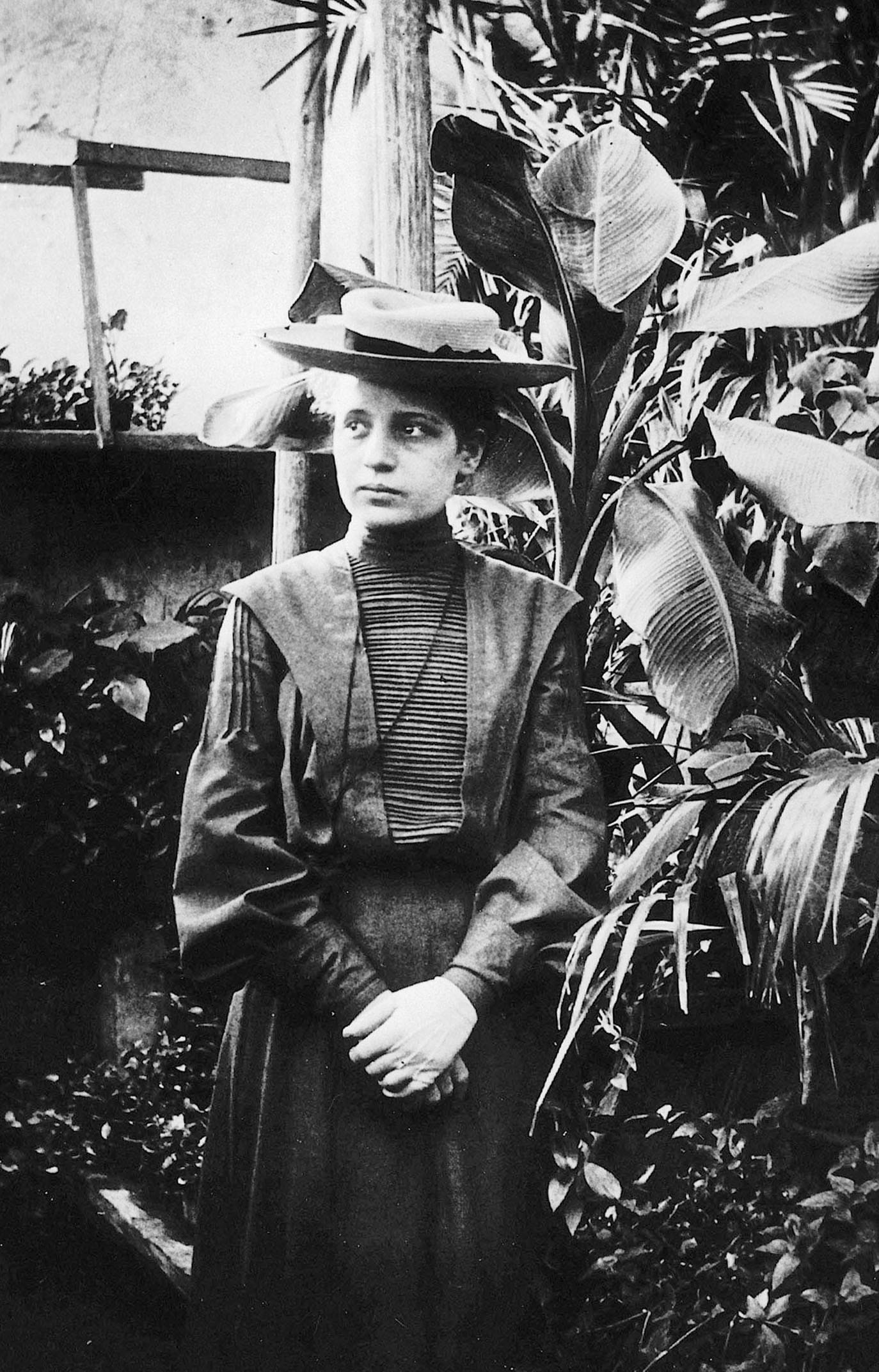
Meitner was born in Vienna in 1878, a city rapidly liberalizing on the edge of the German Empire. Owing to the constitutional reforms enacted in 1867, her father Philipp was one of the first Jewish men to practice law among subjects of the Kaiser. He was committed to liberal ideals and was a civic-minded man-about-town; he and his wife Hedwig regularly hosted meetings of the local intelligentsia at their home when Lise was a young girl. She remembered the time fondly, reminiscing on the "extraordinarily stimulating intellectual atmosphere" that permeated the family home1. Like most Austrian girls at the time, she finished public schooling at 14, after which most girls were expected to either become homemakers or teachers (below the university level).
Meitner had other plans. She spent a few unhappy years teaching French, but her fortunes quickly changed: in 1897, universities began admitting women to their undergraduate programs. Since there were no programs available to train young women to pass the entrance examination, Meitner was tutored by Arthur Szarvassy, a physicist who had just completed his doctoral studies. Under his tutelage the mammoth curriculum was compressed into just two years of study. With the encouragement and support of her father, to whom she turned for advice during this time, Meitner passed the exam and was admitted to the University of Vienna in 1901.
At the university she immediately found herself at the epicenter of modern physics. She studied under Ludwig Boltzmann, an enthusiastic lecturer and accomplished physicist. By the time Meitner took her seat in the dilapidated building that housed many of his lectures, Boltzmann had made foundational contributions to a new kind of atomistic physics: statistical mechanics. Boltzmann's mechanics described the relationships between atoms, their movements in space, and their energy in terms of probabilities. Modern students of physics are taught this framework in almost every undergraduate physics and chemistry degree program. Its eventual dominance belied its contentious history. Boltzmann's detractors would constantly attack his work as unprovable, given that the existence of atoms was still in dispute. By 1908, Albert Einstein and Jean Baptiste Perrin, in their theoretical descriptions of the jittery, random motions of atoms in solution, would provide the death blow to the remaining doubters.
Boltzmann influenced the young Meitner not through his discoveries, but through the way he humanized the practice of science. She remembered him as an extraordinarily dynamic instructor, and she described him as an endearing and committed shepherd of his flock of students:
He not only saw to their knowledge of physics, but tried to understand their character. Formalities meant nothing to him, and he had no reservations about expressing his feelings. The few students who took part in the advanced seminar were invited to his house from time to time. There he would play for us—he was a very good pianist—and tell us all sorts of personal experiences.2
Perhaps Boltzmann's greatest impact on Meitner resulted from his relentless battles with the anti-atomists who relentlessly pilloried his work. As Meitner listened to his recounting of the intellectual drama that played out, she became convinced that science was about more than reasoning. If good science required logic, great science required commitment, perseverance, and fortitude. That fortitude would serve Meitner at least as much as it served her science in the coming decades.
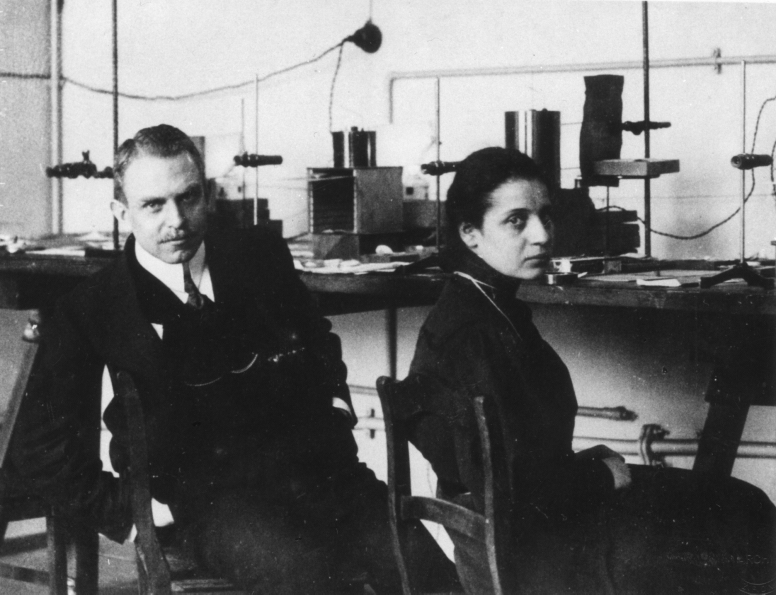
In 1907, Meitner moved to Berlin. There she began the next phase of her career that would span more than thirty years and yield many lifelong friendships. It was there she met and attended the lectures of Max Planck, at the time already quite well known, soon to be immortalized in the coming quantum revolution. She would also be a regular attendant at gatherings featuring Planck, Albert Einstein, and James Franck, all of whom would eventually become Nobel laureates. Perhaps the most consequential relationship was the one she began with Otto Hahn, an experimental chemist from Frankfurt trained in the incipient field of radiochemistry.
They began working together immediately. As women were not yet legally allowed to attend Prussian universities, Meitner was forced to work in a basement room of what is now the Humboldt University of Berlin (although this restriction was soon lifted, Meitner faced sexist discrimination throughout her career). Meitner and Hahn nevertheless quickly bonded, often spending evenings working together until 8 p.m., their experiments occasionally punctuated by musical reprieve:
When our work was going well we sang duets, mostly Brahms Lieder, which I could only hum, while Hahn had a very good singing voice. … If he was in an especially good mood he would whistle large sections of the Beethoven violin concerto, sometimes purposely changing the rhythm of the last movement just so he could laugh at my protests.3
Their scientific partnership proved extremely fruitful: within two years, they had published nine articles, where they documented the emissive behavior and energies of several radioisotopes and even identified new ones. They initially focused on the process of beta decay, whereby unstable atoms were released highly energetic beta particles. Meitner and Hahn moved to the newly inaugurated Kaiser Wilhelm Institute (KWI) in 1912, with Hahn given the title Professor and a substantial salary and Meitner coming to the institute as a "guest" with no pay. Their collaboration continued even during World War I. In 1918 they submitted a joint article on the "Mother Substance of Actinium", a newly discovered element they named protactinium. The next year, Meitner was finally promoted to the rank of Professor.
Meitner continued working in the burgeoning field of nuclear physics. Enrico Fermi, another future Nobel laureate, had set his group to the task of using neutrons to induce artificial radioactivity in as many elements as possible. The Fermi group was identifying new “activities”, radioactive substances with unique decay properties, and publishing their results frequently. The periodic table, its basic principles outline decades before, still seemed to provide for endless discoveries. By 1934, Meitner wrote to Hahn that the Fermi group's results were of "consuming interest" to her, and she insisted they work together to follow up on such exciting findings4.
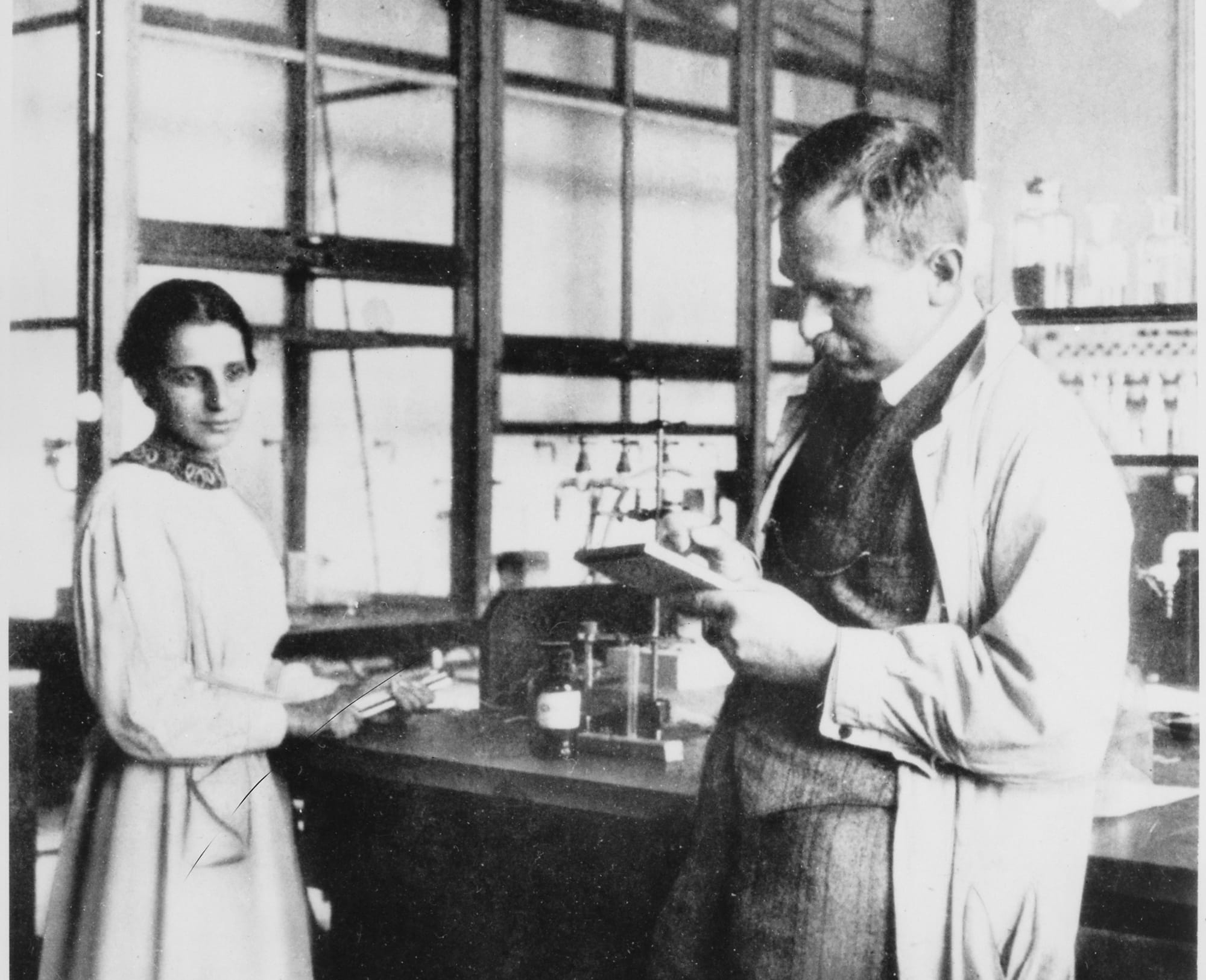
At KWI, Meitner and Hahn worked together, but their scientific strengths were distinct. Hahn was a chemist of extraordinary rank, with Meitner often comparing his work favorably to that of their highly regarded competitor Irène Curie. He was especially skilled at chemical preparations, separations, and purifications required for radiochemistry. Meitner certainly didn't shy away from experiments, and she employed several assistants to assemble laboratory equipment and run experiments with her. Experimental acumen aside, her greatest skill, and ultimately her most significant contribution, was her physical and mathematical intuition.
At the time, Meitner and Hahn presumed that atomic nuclei changed by small degrees; large changes in mass during the course of a single reaction, even a radiochemical one, were seen as extremely unlikely if not impossible. They also had become attached to the erroneous idea that elements beyond uranium—the transuranes—would chemically resemble transition elements like rhenium, osmium, and iridium. These hypotheses, though guided by previous findings in physics, would greatly impede their progress for the next several years.
Meitner and Hahn began by aiming a neutron source at uranium in order to induce radioactivity. Since the "induced" radioactivity in their experiments were much weaker than the natural radiation of the starting material, they decided to chemically separate the starting material from the final products. They dissolved the reaction in various solutions, eventually precipitating out the desired substances, which they believed were the transuranes. The "filtrate" left behind after precipitation was ignored.
The chemical separation process provided some inkling of the identities of final products, but it wasn't nearly enough. Radioactive isotopes (elements with different numbers of neutrons in their nuclei) were known to "decay" into other elements, emitting measurable radiation in the process. Each decay process occurred at a different rate. The decay rates provided the team with a unique signature for each radioactive species.
Their task, given the chemical and radioactivity data, was to build a coherent sequence of isotopes: starting "mother" materials, struck by neutrons, decaying into "daughter" substances, which might undergo further spontaneous decay. For longer lived species, additional chemical separation allowed direct measurement of the decay of the mother substance and the appearance of the daughter substance. For a process whose decay time made separation difficult or impossible, the substance was exposed to the neutron source for different lengths of time, allowing for a more confident assignment of decay sequences.
Their results were confusing: they identified ten separate radioactive decay processes, all apparently beginning with uranium. One of them was unambiguously assigned to uranium itself as its trivial chemical isolation and longer decay time of 24 minutes left little doubt. Two other decays of 10 and 40 seconds were also assigned to uranium since they emitted beta particles (uranium was known to undergo beta decay upon neutron irradiation) and appeared to precede the appearance of the decays they believed were transuranes. The rest of the decays were assigned to transuranic elements.
From the ten initially identified processes, they built three primary decay sequences, each starting with uranium, that decayed into successive transuranic elements. Each sequence contained one of the uranium decay activities: the shortest occurring through neutron capture, the next by emission of two neutrons simultaneously, and the longest by emission of an alpha particle.
At the time, it was known that certain processes favored different amounts of energy. Neutron capture, whereby an element literally “captured” a neutron into its nucleus, favored slow, low-energy neutrons. Faster, high-energy neutrons had been observed to induce alpha decay: the incoming neutron struck the nucleus with enough energy to eject an alpha particle. Meitner performed follow-up experiments showing that the shorter two decay processes could be induced by any kind of neutron, fast or slow.
The longer, 24-minute decay was well understood. The assignment of the shorter processes were far from certain. Although the apparent mother-daughter relationships made sense, especially when combined with their assumptions about the presence of transuranic elements in the precipitate, the physical explanation was lacking. It was difficult to explain how a single starting isotope (which they believed to be uranium-238) could possibly give rise to three separate decay sequences. Meitner came up with a combination of processes, one of which involved the release of alpha particles, even though alpha particles had not been seen in their experiments. Some of the proposed mechanisms would only occur with faster, high energy neutrons, yet Meitner and Hahn observed the same processes, in the same proportion, with slower neutrons.
Conflicting results continued to pile up: Meitner, Hahn, and another physical inorganic chemist, Fritz Strassmann, also identified three separate decay processes after exposing thorium to their neutron source. These results were no more explicable than those of uranium within their framework. How could three separate decay processes result from the same isotope? The fact that there were now two radioisotopes displaying such behavior made the problem seem intractable.
Over the next four years, Meitner would struggle to come up with a physically realistic explanation for these results. Hahn was satisfied with their apparent discovery of transuranes, even concluding one of his reports by declaring "Above all, their [the transuranes] chemical distinction from all previously known elements needs no further discussion." Meitner never accepted their interpretation as final. It was as inelegant as it was unlikely, requiring assumptions that seemed inconsistent with their observations. Reflecting on the work, she would later say "I was always unhappy about it because I couldn’t understand, ‘How can the atomic number keep rising with the same mass?’ That’s what I kept asking Weizsäcker [another scientist at KWI]: How is that possible? You see, I was never satisfied …"5
Within the institute, the scientists’ minds were mostly occupied by their studies of radioactive decay. That was about to change.
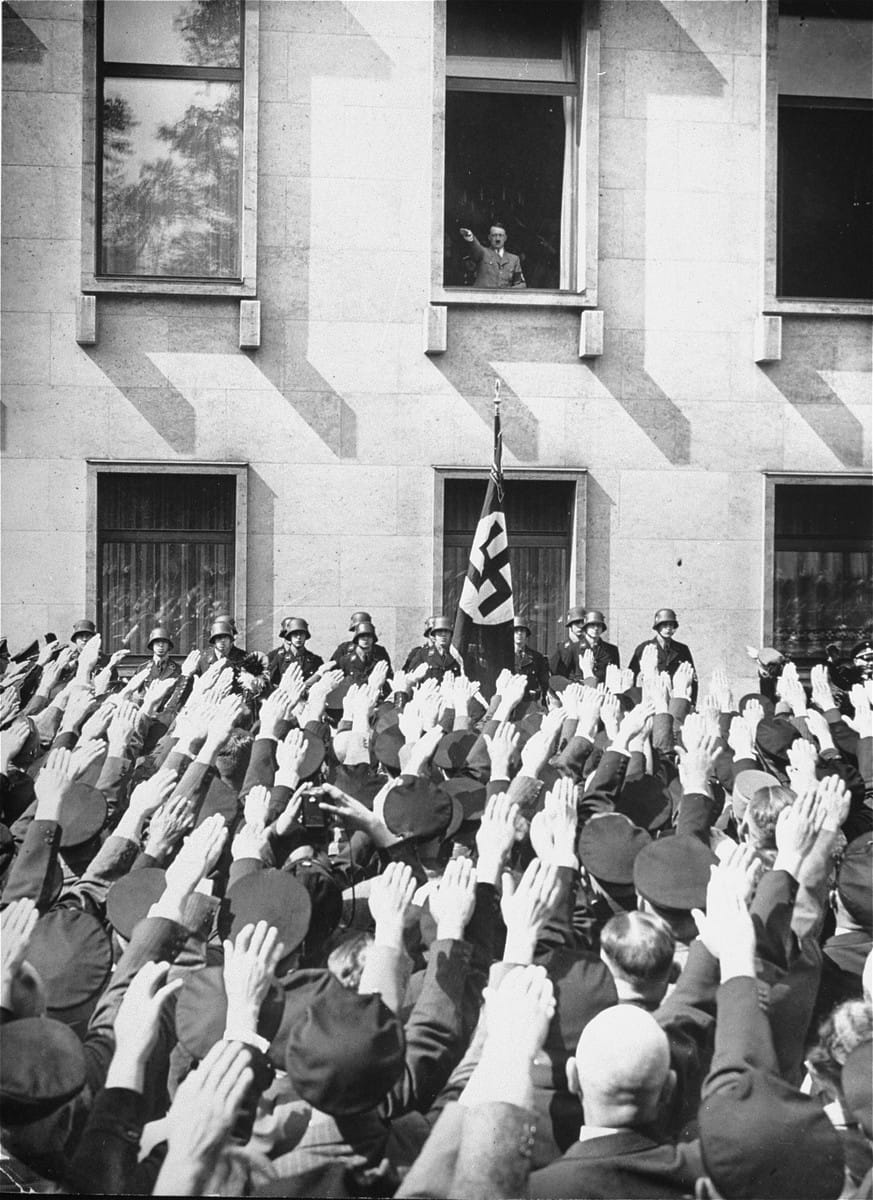
On January 30, 1933, Annemarie Schrödinger paid a visit to Meitner’s apartment. The two met when Annemarie’s husband, Erwin, came to Berlin in 1927. Erwin was a major figure in the “quantum revolution” happening in Europe, but Annemarie did not visit for a riveting discussion of electrons and protons. The women tuned into a radio broadcast: Adolf Hitler had just become chancellor of the nascent Third Reich.
Like so many other autocrats, Hitler came to power through an election, and although his party failed to win a majority, he immediately set about consolidating power. In the six years before the invasion of Poland in 1939, German society would be reforged by Hitler, his loyal disciples, and collaborationist functionaries into a totalitarian ethnostate. This was Gleichschaltung: alignment. This short time would see the rise of mandatory registration of children into the Hitler Youth; the stripping of citizenship and civil rights from every Jew; the rebuilding of the German armed forces in direct violation of the Treaty of Versailles that brought and end to the bloodshed of World War I; the construction of the first concentration camps.
Under the Kaiser, the liberalizing German state largely supported its scientists and allowed them to operate independently, even building public institutes like KWI. That relationship began to change as the Nazis took power. The KWI’s parent institute, the Kaiser Wilhelm Gesellschaft, was forced to raise the swastika. The “Law for the Restoration of Professional Civil Service” forced Jewish academics from their positions in both the government and at universities. It would eventually become impossible to hire anyone with known anti-Nazi sentiments at KWI.
Moral clarity would guide the behavior of some of Meitner’s colleagues. Albert Einstein, himself no stranger to anti-Semitic vitriol, denounced the Nazis publicly and never returned after a 1933 visit to California. James Franck, born into a Jewish family, relinquished his directorship of the Second Physics Institute in Göttingen, writing that he would “refuse to make use of this privilege [here he referred to exceptions for wartime service; he fought for Germany in World War I], even though I also understand the position of those today who consider it their duty to hold out at their posts.”6 His former colleagues in Göttingen equated his actions with “sabotage.”7
Many others would not display such moral certitude, particularly after witnessing the high profile dismissal of Fritz Haber, the director of the KWI for Physical Chemistry and Electrochemistry. There were countless dismissals of “non-Aryans” after the Civil Service law went into effect. Students and faculty in Germany took almost no collective action in resistance, save for a memorial service for Haber after his death in 1934. Meitner’s own assistant even wore a brown shirt to work after joining the Nazi SA (Sturmabteilung, “storm division”, a paramilitary organization whose uniforms were brown). Werner Heisenberg, in a letter to Max Born, would go so far as to suggest that less experienced scientists could be jettisoned without damaging German science. Otto Hahn, Meitner’s ever-steady friend and partner in radiochemistry, even described Hitler as living “almost like a saint.”8
Hahn was desperate to avoid Haber’s fate, and he acted decisively:
When Haber left his institute in the summer of 1933, Hahn stepped in as interim director. In that position he followed the orders Haber had refused to carry out: he dismissed nearly all personnel and dismantled the institute, paving the way for the new Nazi-appointed director, Gerhart Jander, who arrived in the fall. … he had done the Nazi regime’s dirty work and lent them his good name in the process, receiving nothing for it but the vague hope that he and his institute would be left alone. It was a poor bargain, and now the Nazis knew his price.9
Meitner found it difficult to leave the life she had painstakingly built in Berlin, but piece by piece the Nazis captured her institute and whittled away her fortitude. She was dismissed from her teaching duties at the University of Berlin in 1933. Hahn’s name began subsuming Meitner’s even in joint publications. In March 1938, Hitler illegally annexed Austria. Her brother-in-law Jutz Frisch was imprisoned in Dachau after Kristallnacht. Kurt Hess, a fervent Nazi who worked on the floor above Meitner, launched inflammatory and racist invective against her: “The Jewess endangers the institute.”10 Only once it became impossible for her to remain did she finally agree to leave.
Her final months in Berlin were a whirlwind of clandestine correspondence as her friends helped arrange her escape. After her train pierced that misty summer morning in July 1938, she would never return. She eventually settled in Stockholm at the Royal Swedish Academy of Sciences. Otto Hahn and Fritz Strassman remained in Germany.
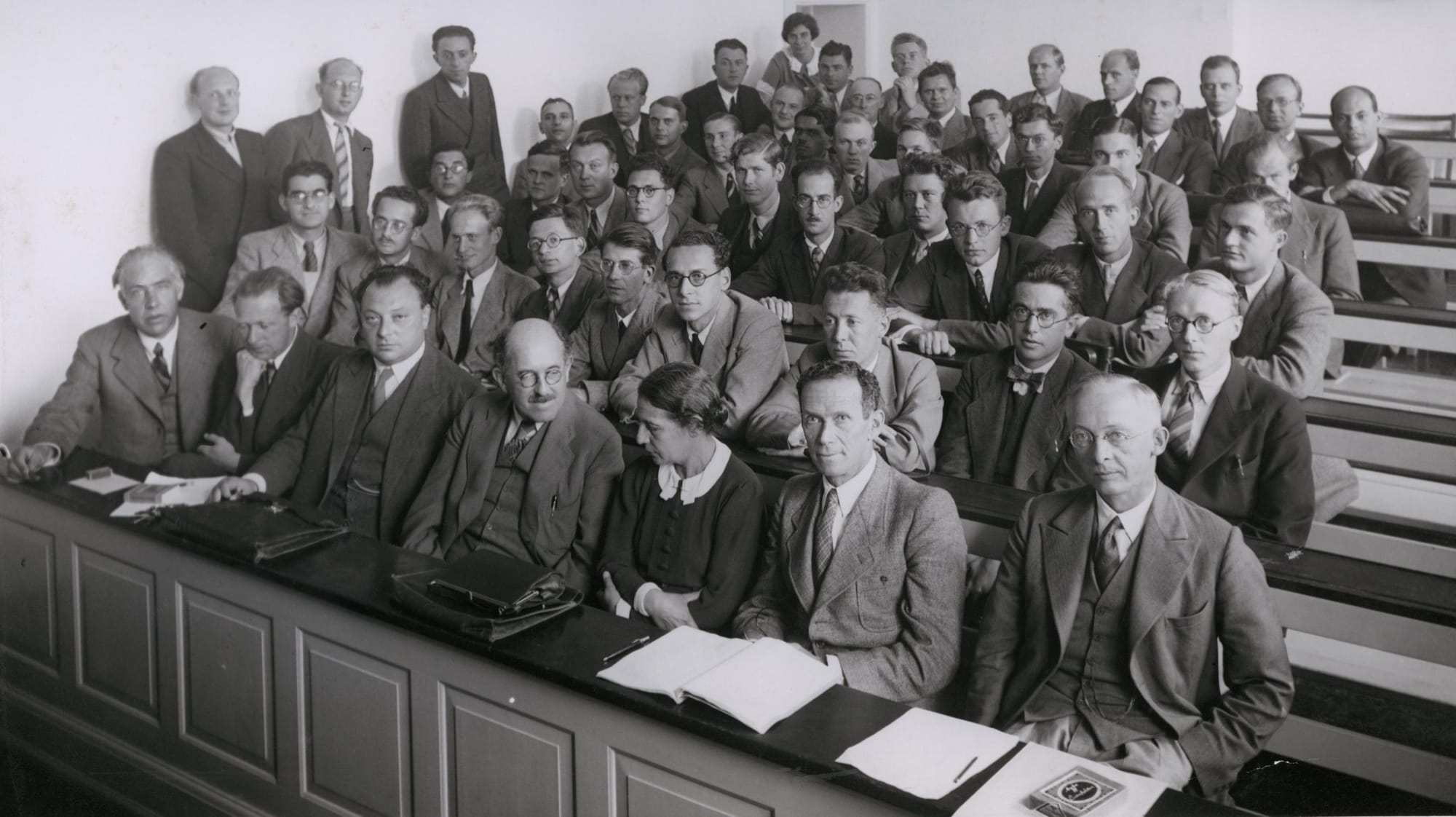
The scientific fervor surrounding the field of radioactivity was heating up. In 1937, the Curie group had reported a new, intense beta decay signal with a decay time of 3.5 hours from a sample of uranium that had been struck with neutrons, just like in Meitner and Hahn's experiments. Whereas the Berlin group routinely purified and separated the reaction, the Curie group analyzed the entire mixture together. It was an extremely consequential oversight. The Berlin group immediately set about analyzing their previously ignored "filtrate."
By October 1938, Strassmann had read the Curie group's latest report that detailed their attempts to chemically separate the new 3.5-hour decay from the mixture. Meitner and Hahn regarded the Paris group as second-rate chemists, and they pejoratively named the new activity “Curiosum”. Strassmann knew better. Suspecting the presence of radium, he immediately set out to separate it using an improved purification scheme. Hahn wrote to Meitner, providing his interpretation: the uranium was somehow expelling alpha particles as a result of being struck with slow, low energy neutrons (alpha decays were known to require higher energies). To explain the data, he suggested the presence of multiple radium “isomers”: nuclei whose protons and neutrons became "excited" into higher energy levels after interacting with incoming neutrons.
Meitner was unconvinced, expressing confusion and disbelief in her letters to Hahn:
I am extremely eager to think over how Ra [radium] or Ac [actinium] isotopes could be produced if you would only write more factual details. I would definitely say nothing to anyone. Why is it that you think that there are several substances, did you obtain several half-lives? Why do you think it can be enhanced? Did you get considerably more with slow neutrons? … Why do you think there are several isomers? Are more than two substances observed?11
Fleeing Germany brought Meitner immediate safety, but it strained her scientific collaboration with the rest of the Berlin group. The prevailing political environment made it impossible for them to openly collaborate and publish together. Hahn and Meitner met in secret in Copenhagen on November 13. He was scheduled to give a talk, but he and Meitner met to discuss their as-yet incomprehensible results.
The physics were impossible to make sense of. Meitner sent Hahn back to Berlin with a message: they needed to reevaluate their work. Strassmann indicated as such, later remarking "... he [Hahn] urgently requested that these experiments be scrutinized very carefully and intensively one more time. … Fortunately L. Meitner’s opinion and judgment carried so much weight with us in Berlin that the necessary control experiments were immediately undertaken."12
The Berlin group had been using barium as a "carrier" to selectively purify their radium in earlier experiments. They next attempted to separate the radium from the barium, but what they found was even more confusing: the substance they previously assumed was radium was chemically indistinguishable from barium. Somehow, the uranium nucleus, with its 92 protons, decayed to barium, with only 56 protons. Hahn did not recognize the significance of these results, and he suggested to Meitner that they publish separately, since a direct collaboration politically impossible. Still, from Hahn's candor about their results, it was obvious that Meitner remained an integral and active part of their research group.
Meitner's biographer Ruth Lewin Sime contextualized the situation:
And now, as so often before, Hahn and Strassmann were expecting Meitner to interpret the findings and place them in their physics context. Without her, Hahn was somewhat adrift. The idea of uranium “bursting” crossed his mind, but he was thinking of nuclear mass rather than atomic number: he did not yet realize that uranium had split in two.'’ It was not solicitude for Meitner that kept Hahn and Strassmann from talking to other physicists; as a team they had been so close, so familiar with each other’s work and thought processes, that she was still, in every essential way, one of them.13
Meitner wrote to Hahn, expressing excitement at their findings: "At the moment the assumption of such a thoroughgoing breakup seems very difficult to me, but in nuclear physics we have experienced so many surprises, that one cannot unconditionally say: it is impossible."14 Clearly, Meitner understood the possibility that the uranium had burst apart.
With her nephew and collaborator Otto Robert Frisch, Meitner outlined a theoretical process by which unstable nuclei like uranium could break apart when struck by neutrons. They were inspired by the "liquid drop" model of the nucleus. In this model, the nucleus absorbs energy and begins an unstable wobble, finally expelling either a particle or else radiating its excess energy. The pair calculated the amount of energy they expected to be released based on their model: 200 MeV, exactly the amount they observed in their experiments. Until this point, no one had thought such a viscous, fluid nucleus could actually split apart. Meitner and Frisch, armed with Hahn and Strassman's radioactivity data, knew they had found something explosive.
Everything began falling into place. The "multiple isomerism" could now be explained as isotopes of smaller elements: uranium could split into different isotopes of barium and krypton, with different atomic masses and different decay rates. Gone were the 10- and 40-second decay times of uranium, replaced by a single, cataclysmic shattering of the uranium nucleus. Frisch learned from an American biologist, William A. Arnold, that living cells can split in a process called "binary fission." When he suggested to Meitner that they name their process fission as well, she agreed.
The discovery of nuclear fission would herald a new era for science: the atomic age. It would also yield a Nobel Prize. Lise Meitner’s role in its discovery surely warranted her sharing in the Prize. Otto Hahn, one of her dearest friends, ensured that would not happen.
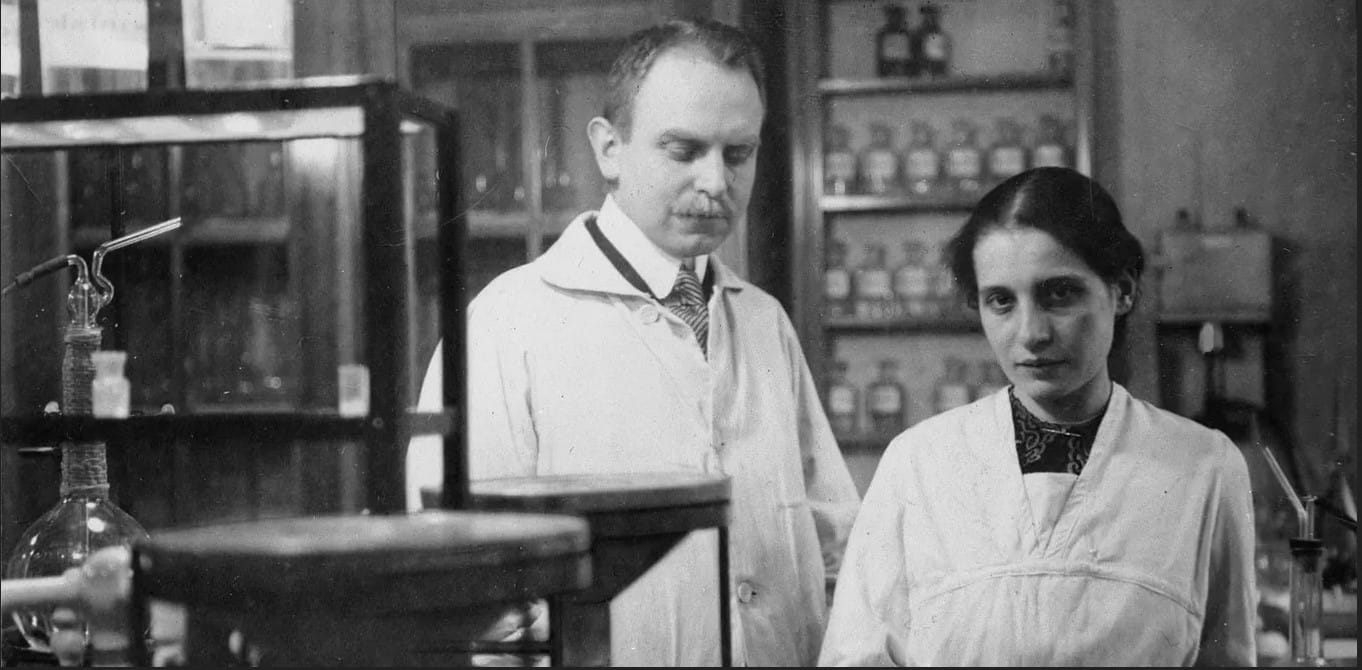
Meitner and Hahn spent decades working together on what eventually became the discovery of nuclear fission. Her exile from Germany, forced upon her by the Nazis, did not end their collaboration, as evidenced by the many letters exchanged before and after the war. She and Otto Robert Frisch took Hahn and Strassmann’s chemistry and weaved it into a cohesive model that changed the way physicists saw the nucleus forever. In spite of all this, and against the historical record of their accomplishments, Hahn never acknowledged Meitner’s contributions to the discovery of fission. He would spend the rest of his career explaining fission as a singular triumph for himself. Fission was a boon for the glory of Hahn and German science, with Meitner a footnote at best, a hindrance at worst. Why?
The end of the war brought Germany a crushing defeat. Meitner, and the rest of the world, demanded answers from the collaborationists that would have required them to acknowledge their role in the atrocities of the Third Reich. Hahn and his compatriots had no interest in self-reflection; they wanted to suppress the past and recast Germany’s defeat into a triumph. Hahn dismissed the role of physics in the discovery of fission before the war as a matter of political expediency, but in 1945 his motivations were more complex:
Hahn was calling on fission to serve again—not just himself this time, but his defeated country. He was famous, and fission was more sensational than ever. He would use the importance of the discovery and his personal prestige to call attention to Germany’s misery and rebuild German science. He saw no purpose in looking back to the injustices of the Third Reich; he felt no personal necessity to make amends. He wanted the discovery to be his, alone. And Germany’s.15
In this retelling of history, German scientists had nothing to apologize for. Their failure to produce a working reactor, which would have enabled construction of their own atomic bombs, became a moral triumph; their failure to produce a bomb was the result of principled opposition. Allied science built weapons that massacred hundreds of thousands of civilians; German science produced the beautiful discovery of fission and built no atomic bombs (ironically, while Hahn had worked on the abortive German fission project, Meitner outright refused to help the Allies build their bombs). There was little appetite among them for an honest accounting of the war or the toll the Third Reich exacted on the world. To do so would have partly implicated them; they instinctively recoiled.
Against this backdrop, Hahn marginalized Meitner to cast himself as the man who ushered in the atomic age. His efforts brought him his Nobel Prize in Chemistry. It was awarded in secret in 1944, as Germans were forbidden from receiving the Prize after Carl von Ossietzky, a concentration camp survivor, was awarded the Peace Prize in 1935. With his solo Prize in hand, he would become one of the most famous men in German science of his day.
Meitner and Hahn argued bitterly in their correspondence after the war. Hahn dismissed the atrocities as behaviors inherent to all peoples, not unique to Nazi Germany. Meitner in turn implored him to face the terrible things the Nazis had done and recognize his own complicity: “If the best Germans do not understand now what has happened and what must never happen again, who should instruct young people that the path that was tried was tragic for Germany and the world?”16 Despite her best attempts, their close friendship was over. Hahn had brushed her off first for political expediency before the war, then for personal glory after the war. He willingly and voluntarily continued the Nazi’s “war against memory” against the woman who dared him only to confront himself.
Hahn’s Nobel ceremony took place on December 10, 1946 in Stockholm, and Meitner accompanied Hahn and his wife Edith during their stay. The press wrote of Hahn’s “world-famous pupil.” Arguments between Meitner and Hahn continued even during the visit. Edith plead for a cessation of hostilities, for an end to talk of politics. In his Nobel lecture and subsequent public appearances, Hahn would advocate for Germany and German science, refusing to abandon his revisionism. Meitner’s impassioned pleas for self-reflection were ignored.
Hahn had fully extricated any trace of Lise Meitner from her most consequential discovery. In doing so he also obliterated any remaining trace of their friendship:
Several days went by before Lise fully understood that she no longer had a place in Otto’s life, or even his memory. When asked by the press to reflect on his life’s work, he did not speak of their thirty years together. When he talked about fission, he did not mention her contributions. Not once, in any of his public statements, did he so much as speak her name. Lise’s friends were shocked. They wondered at her restraint, but there was nothing she could do: she could not beg for fairness, force him to remember what he had willed away, breathe life into a friendship that had become a hollow shell.17
Meitner never received any Nobel Prize, in chemistry or physics. She and Otto Robert Frisch were nominated several times: in 1946, 1947, and 1948. Even in 1944 the committee had briefly reconsidered its sole award to Hahn but ultimately left their decision in place.
The Nazis stripped Lise Meitner of her position, her livelihood, and most of her possessions. They would have ultimately killed her had she fled much later than she did. With the Nazis defeated and her life spared, her story could have ended differently. Otto Hahn, expedient as he was dishonest, ensured this would not happen. He immolated her memory on the altar of German science for the glory of the Fatherland and for himself. The billowing smoke polluted Meitner's legacy for decades.
It was not until 1997, almost thirty years after her death, that she was immortalized in the naming of a new radioactive element: meitnerium. It was a poignant reminder that no victories in the war against memory are final.
Update 4:32 pm Aug 6 2026: Niels Bohr was misspelled in one of the image captions. The typo has been corrected.
References
Sime, Ruth Lewin. Lise Meitner: A Life in Physics. First Paperback Printing 1997. California Studies in the History of Science, Volume 13. University of California Press, 1997.
Encyclopedia Britannica provides an excellent description of the plant and animal life of Germany and its geography.
Notes
Primary sources (letters, correspondence, recorded statements) are cited in Sime. The page number in Sime where each quote can be found in context is given below.
1 p. 4.
2 p. 14.
3 p. 35.
4 p. 165.
5 p. 179.
6 p. 139.
7 p. 140.
8 p. 143-4.
9 p. 146.
10 p. 184.
11 p. 224.
12 p. 229.
13 p. 234.
14 p. 235.
15 p. 324.
16 p. 338.
17 p. 341.